With each new generation of young Americans, there is a subsequent event, establishment or way of life to question and, ultimately, attempt to change or bring down altogether. Whether it’s marches for civil rights and equality, protests against questionable wars with no clear conclusion, or simply trying to gain acceptance for different ways of dressing or thinking, there has never been a shortage of conflict and turmoil amongst the many different subcultures that make up our society. Although we have obviously made great strides in many respects, the human race still has a long way to go before a true sense of peace and harmony can resonate among us all.

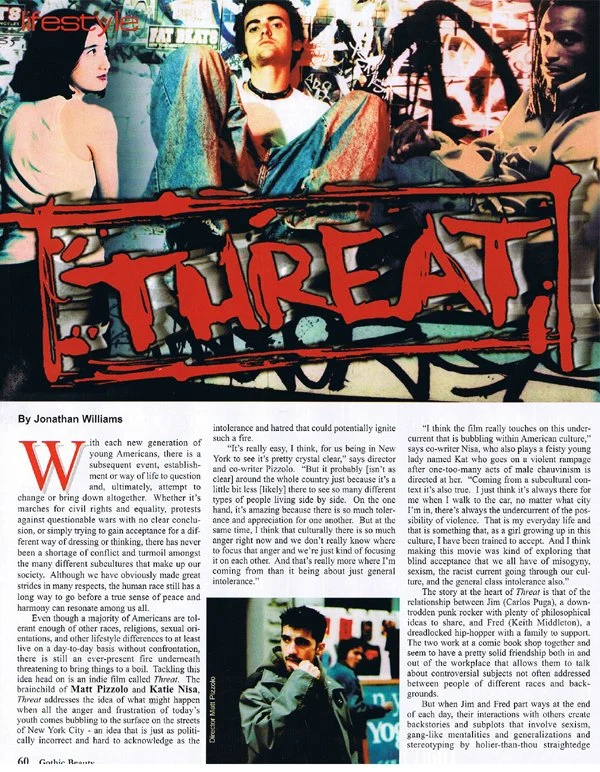
Even though a majority of Americans are tolerant of other races, religions, sexual orientations, and other lifestyle differences to at least live on a day-to-day basis without confrontation, there is still an ever-present fire underneath threatening to bring things to a boil. Tackling this idea head on is an indie film called Threat. The brainchild of Matt Pizzolo and Katie Nisa, Threat addresses the idea of what might happen when all the anger and frustration of today’s youth comes bubbling to the surface on the streets of New York City – an idea that is just as politically incorrect and hard to acknowledge as the intolerance and hatred that could potentially ignite such a fire.

“It’s really easy, I think, for us being in New York to see it’s pretty crystal clear,” says director and co-writer Pizzolo. “But it probably [isn’t as clear] around the whole country just because it’s a little bit less [likely] there to see so many different types of people living side by side. On the one hand, it’s amazing because there is so much tolerance and appreciation for one another. But at the same time, I think that culturally there is so much anger right now and we don’t really know where to focus that anger and we’re just kind of focusing it on each other. And that’s really more where I’m coming from than it being about just general intolerance.”

“I think this film really touches on this under-current that is bubbling within American culture,” says co-writer Nisa, who also plays a feisty young lady named Kat who goes on a violent rampage after one-too-many acts of male chauvinism is directed at her. “Coming from a subcultural context it’s also true. I just think it’s always there for me when I walk to the car, no matter what city I’m in, there’s always that undercurrent of the possibility of violence. That is my everyday life and that is something that, as a girl growing up in this culture, I have been trained to accept. And I think making this movie was kind of exploring that blind acceptance that we all have of misogyny, sexism, the racist current going through our culture, and the general class intolerance also.”

The story at the heart of Threat is that of the relationship between Jim (Carlos Puga), a down-trodden punk rocker with plenty of philosophical ideas to share, and Fred (Keith Middleton), a dreadlocked hip-hopper with a family to support. The two work at a comic book shop together and seem to have a pretty solid friendship both in and out of the workplace that allows them to talk about controversial subjects not often addressed between people of different races and backgrounds.

But when Jim and Fred part ways at the end of each day, their interactions with others create backstories and subplots that involve sexism, gang-like mentalities and generalizations and stereotyping by holier-than-thou straightedge kids. All of this angst comes to a head one night when Fred, trying to remain open-minded about Jim’s musical tastes, shows up at a hardcore show with some of his hip-hopper friends.

“We’re both coming at it from sort of a subcultural perspective,” says Pizzolo. “Katie is originally from Woodstock, N.Y., which has a big sort of activist community to it. I grew up mostly in the hardcore scene, which is a lot of where the movie comes out of. But at the same time, I was involved in hip-hop and industrial.

“For me growing up, I was always really comfortable going to all different sorts of countercultural venues and groups,” he continues. “What I always found was if I was going to a goth club and we were all chilling listening to Coil and Chemlab, it’s basically the same thing as what the bands are saying at the hardcore shows and what the rappers are saying at the hip-hop clubs, but the kids really look at each other as being very different even though they’re all sort of aligned as a vast counterculture that’s just incredibly fragmented. In the making of [Threat] we were coming from all different groups. There were hardcore kids and there were straightedge kids and there were ravers and there were goth kids and there were hip-hop kids and there were vegans and there were people who hated vegans, all kind of working together because we were focused on something beyond just our differences and more about our station together at the end of the food chain.”

Even though it’s just a minor incident that sets things in motion in Threat, it isn’t long before the streets are filled with senseless bloodshed and fatalities, leaving the survivors bewildered.

“I think part of what we’re saying is it’s not going to take much to set something off because there is so much blatant anger and hostility and people don’t know what to do with it,” says Pizzolo. “The thing that starts off a riot will often, in retrospect, not seem like it would have resulted in that. But it’s because people are kind of on the edge of the knife in general. You never know what will do it.”

Another thing that comes across well in Threat is that it can be easy to adopt a certain way of thinking and forget that not everyone thinks that way. That’s what happens when Marco (David R. Fisher) starts a straightedge gang called OLD (One Less Drunk) in response to one member’s recollection of losing a friend to drunk driving.

“It’s sort of a weird thing for me because partly what I didn’t want to do was look outside and judge other subcultures,” he continues. “I grew up largely in the straightedge scene and I don’t smoke or drink or do drugs. I don’t wear the Xs anymore, but I still sort of identify with that. With something like straightedge it’s really easy to feel like it’s a very kind of noble thing, it’s really easy to become a zealot. So for me with the straightedge thing, I thought it would be interesting to look at something that I actually do feel is a positive thing and show how even that can be taken into this horrible direction, which is where one of the characters really pushes it.

“A lot of us have had experiences where we’ve lost very good friends from drunk driving,” he adds. “Neil [Rubenstein], who plays Ruby, I grew up with, and there was no script for the scene where they introduce OLD. But we had a friend who died in a drunk driving accident and I was just like, ‘Well, tell that story.’ And it’s sort of a weird scene because he’s mumbling and telling his own story and he has really mixed feelings.”

And even when responding to harmful and ignorant behavior, Threat shows that it can be easy to go just a little too far.

”If you think about even my character when she is just fed up with what this world has been giving her and she lashes out against men harassing her in the street,” says Nisa, “it’s like once people get a taste of it, they keep pushing it and pushing it until it gets to such an extreme that watching it should hopefully be disturbing. I think it’s interesting when people see a little girl fighting back. At first they’re like, ‘Yeah!’ and then as she keeps going they’re like, ‘Oh! Wait a minute. Two seconds ago I was really cheering for this little girl and now I’m kind of freaked out.’ How far is too far? What are we so desensitized to?”

To help hammer these messages home, Threat enlists the talents of several musicians for the film’s score, soundtrack and a CD of mash-ups pitting hardcore and metal bands like Minor Threat, Glassjaw and Killswitch Engage against electronica and industrial acts like Holocaust, Drop The Lime and Alec Empire. And it was Empire (best known for his work with Atari Teenage Riot) who was one of the masterminds of the musical contributions, scoring the film and producing the soundtrack.

“Alec Empire came in really early in the process,” says Pizzolo. “I’m a big fan of Alec’s and Atari Teenage Riot and I went up to him after a show and I was like, ‘Hey, man. We’re working on this movie.’ And I gave him a trailer that we put together with some of the early stuff we had done and he got really excited about it. The funny thing is, the trailer [had been] cut against an Atari Teenage Riot song without even asking. Luckily, he thought that was cool. That was really exciting having him on board so early and obviously his music is perfect for the film.”

“I liked their attitude because it reminded me of what we did,” says Empire. “Also I [have been] interested in violence as a subject for music for years – why it’s happening, how it’s happening and so on. I think Threat deals with it in a very special way. I have always seen violence as a key issue that our generation has to deal with on an artistic level. And Threat does exactly that. And it’s coming from the people who experienced it and not from some pseudo-intellectual, aged film director who can only judge it from the outside.”

Being fledgling filmmakers with a cast of unknowns who had never stepped in front of a camera before, Pizzolo and Nisa found the making of Threat to be an eye-opening experience in itself. And the renegade tactics they used in this DIY production leant themselves perfectly to the movie’s attitude and anti-establishment messages.

“Because we didn’t know anything about how to make a film and we were really going through the lines, one thing that we felt we could definitely give to the film was a credibility and authenticity because it really was coming from the places that it’s about and the people that it’s about,” says Pizzolo. “We auditioned people through ads and stuff, but typically in theater an actor comes in and he’s like, ‘I heard there’s this punk, I’ll give myself a Mohawk’… So we kind of got frustrated with that process and we would just go and hang out at the shows and clubs and [find] people that we knew.

“Katie found Keith Middleton, who plays Fred, which is a huge role and it’s a lot of pressure on him because he’s delivering these really intense monologues,” continues Pizzolo. “Katie just saw him on the street and flagged him down and it just so happened that he was on his way to be in Stomp. But we didn’t even know that until after we’d already met with him and were casting him. Katie just saw him and had a good feeling about him. And then the surprising thing is when we finally saw him in Stomp, he's the wild child one, the funny one. If we had seen that, we would never have thought he could be Fred, but he has amazing range.”

Now that Pizzolo and Nisa have established themselves as filmmakers with Threat, already a bit of a modern punk classic, they could easily rely on the Hollywood system for future projects. But with scripts in development with titles like Godkiller and Young Terrorists: Silent War that are obviously just as confrontational and thought provoking as Threat, it doesn’t seem too likely that Hollywood will be completely embracing their ideas anytime soon.

“It’s one thing to make a movie, but you can’t really get it out on your own so we’ve had to do a lot of work out here in Hollywood,” says Pizzolo. “When we were making Threat, it was a blast because even though we didn’t know what the hell we were doing and we were running from the cops and we would sneak in buildings, under conditions like that it’s a really amazing bonding experience.”

And even though Threat has already been released on DVD, Pizzolo and Nisa continue to appear at theater screenings and festivals around the country.

“We didn’t really have to play by the rules because it’s such an obscure movie that people are just going to hopefully discover it in whatever way they’ll discover it,” says Pizzolo. “I feel like if people hear about it playing in theaters, a lot of times they won’t even know the DVD is available or vice versa. We’re lucky in that the DVD is out and there are still theaters contacting us about playing it. The other thing for us was most cinemas that will play a movie like Threat are in metropolitan areas and cater to a specific audience, which isn’t necessarily the only audience for Threat. So we wanted to make sure that as soon as possible it was available to everybody who would find it interesting, even if they’re in a small town in the middle of the country and there’s no theater there. So it’s kind of an egalitarian release.”