Directed by Matt Pizzolo
Written by Katie Nisa & Matt Pizzolo

Matt Pizzolo wasn't really living anywhere then. He was technically homeless, the kind of homeless that a hardcore kid from Plainview falls into when he's just dropped out of an NYU dramatic writing program. He crashed on friends' couches, slept under Ping-Pong tables in dorm buildings after hours, fell asleep in East Village diners and, once in a while, curled up on a park bench.

Ever since he'd dropped out, things had been tense at home and he didn't want to come back to the Island. His friend Katie Nisa was thinking about heading up to Toronto for a while, to figure out things in her head. College was over, high loans looming, and she still didn't know what she wanted to be.

This was about three years ago. Their lives -- caught in that formless whirlpool of the early 20s, ages that don't really matter on a grand scale but seem to be setting the course of your life forever -- were played out upon the backdrop of the East Village in gentrification turmoil and the hardcore scene out of ABC No Rio and CBGB. Suburban kids hanging out amid the dustbin of race, gender and worldview that defines the city streets, they started to think about where they'd come from.

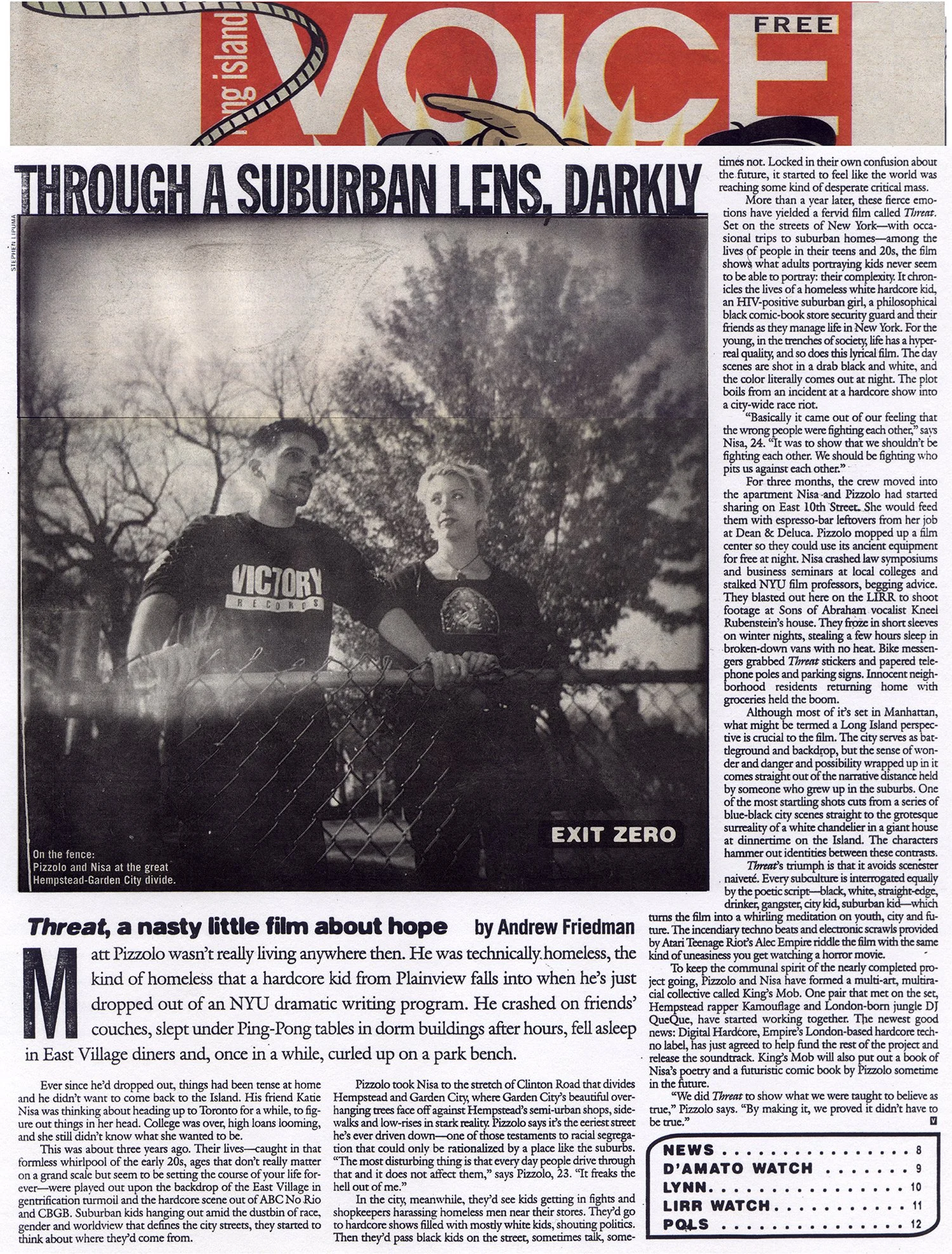
Pizzolo took Nisa to the stretch of Clinton Road that divides Hempstead and Garden City, where Garden City's beautiful overhanging trees face off against Hempstead's semi-urban shops, sidewalks and low-rises in stark reality. Pizzolo says it's the eeriest street he's ever driven down -- one of those testaments to racial segregation that could only be rationalized by a place like the suburbs. "The most disturbing thing is that every day people drive through that and it does not affect them," says Pizzolo, 23. "It freaks the hell out of me."

In the city, meanwhile, they'd see kids getting in fights and shopkeepers harassing homeless men near their stores. They'd go to hardcore shows filled with mostly white kids, shouting politics. Then they'd pass black kids on the street, sometimes talk, sometimes not. Locked in their own confusion about the future, it started to feel like the world was reaching some kind of desperate critical mass.

More than a year later, these fierce emotions have yielded a fervid film called Threat. Set on the streets of New York -- with occasional trips to suburban homes -- among the lives of people in their teens and 20s, the film shows what adults portraying kids never seem to be able to portray: their complexity. It chronicles the lives of a homeless white hardcore kid, an HIV positive suburban girl, a philosophical black comic-book store security guard and their friends as they manage life in New York. For the young, in the trenches of society, life has a hyper-real quality, and so does this lyrical film. The day scenes are shot in a drab black and white, and the color literally comes out at night. The plot boils from an incident at a hardcore show into a city-wide race riot.

"Basically it came out of our feeling that the wrong people were fighting each other," says Nisa. "It was to show that we shouldn't be fighting each other. We should be fighting who pits us against each other."

For three months, the crew moved into the apartment Nisa and Pizzolo had started sharing on East 10th Street. She would feed them with espresso-bar leftovers from her job at Dean & Deluca. Pizzolo mopped up a film center so they could use its ancient equipment for free at night. Nisa crashed law symposiums and business seminars at local colleges and stalked NYU film professors, begging advice. They blasted out here on the LIRR to shoot footage at Sons of Abraham vocalist Kneel Rubenstein's house. They froze in short sleeves on winter nights, stealing a few hours sleep in broken-down vans with no heat. Bike messengers grabbed Threat stickers and papered telephone poles and parking signs. Innocent neighborhood residents returning home with groceries held the boom.

Although most of it's set in Manhattan, what might be termed a Long Island perspective is crucial to the film. The city serves as battleground and backdrop, but the sense of wonder and danger and possibility wrapped up in it comes straight out of the narrative distance held by someone who grew up in the suburbs. One of the most startling shots cuts from a series of blue-black city scenes straight to the grotesque surreality of a white chandelier in a giant house at dinnertime on the Island. The characters hammer out identities between these contrasts.

Threat's triumph is that it avoids scenester naiveté. Every subculture is interrogated equally by the poetic script -- black, white, straight-edge, drinker, gangster, city kid, suburban kid -- which turns the film into a whirling meditation on youth, city and future. The incendiary techno beats and electronic scrawls provided by Atari Teenage Riot's Alec Empire riddle the film with the same kind of uneasiness you get watching a horror movie.

To keep the communal spirit of the nearly completed project going, Pizzolo and Nisa have formed a multi-art, multiracial collective called Kings Mob. One pair that met on the set, Hempstead rapper Kamouflage and London-born jungle DJ Queque, have started working together. The newest good news: Digital Hardcore, Empire's London-based hardcore techno label, has just agreed to help fund the rest of the project and release the soundtrack. Kings Mob will also put out a book of Nisa's poetry and a futuristic comic book by Pizzolo sometime in the future.

"We did Threat to show what we were taught to believe as true," Pizzolo says. "By making it, we proved it didn't have to be true."